.svg)

Institutional tokenized assets 2026: why Wall Street is in
Institutional tokenized assets 2026 are no longer a pilot: BlackRock, JPMorgan and Ondo are building real infrastructure for long-term investors.
.png)
Institutional tokenized assets 2026: why BlackRock and JPMorgan are all in
Institutional tokenized assets 2026 is no longer a research topic for crypto insiders. BlackRock, JPMorgan, and Ondo Finance are now running live infrastructure that moves billions of dollars of Treasuries, money market funds, and settlement flows onto public blockchains. This matters because it marks a shift from experimentation to production. In this article, you will learn who is actually building this infrastructure, why it is happening now, and what it means for long-term investors watching from outside Wall Street.
What are tokenized real-world assets, and why is 2026 different?
Tokenized real-world assets, or RWAs, are traditional financial instruments like Treasury bills, money market funds, and bonds represented as digital tokens on a blockchain. Ownership, transfer, and settlement happen on-chain instead of through traditional custodians and clearing houses.
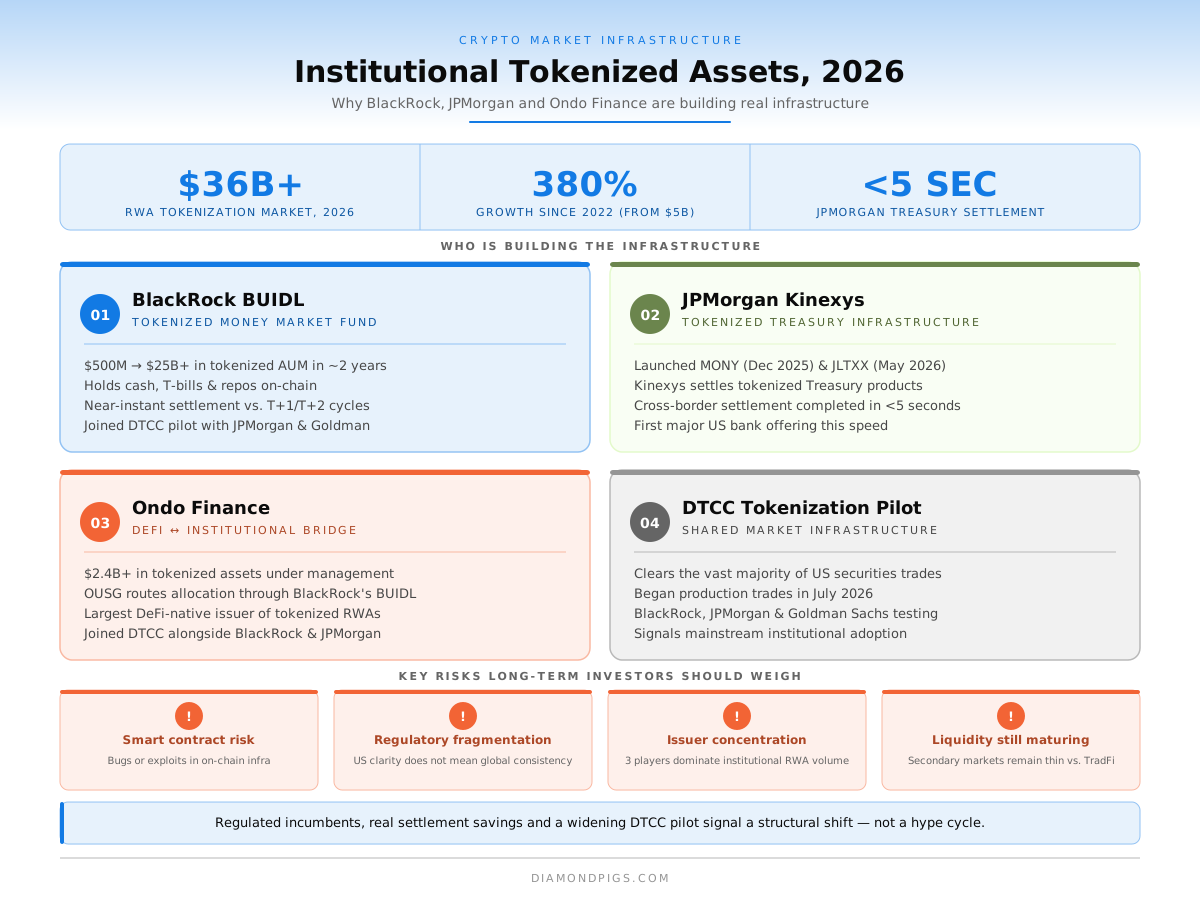
Earlier tokenization attempts, going back to 2017, mostly stayed in pilot mode. Volumes were small and issuers were mid-size fintechs, not global banks. That has changed. The RWA tokenization market grew from roughly $5 billion in 2022 to more than $36 billion in 2026, a 380% increase, according to industry research from crypto.news. As a result, tokenization has moved from a side project to a core part of how the largest asset managers and banks plan to operate.
The difference in 2026 is who is building. BlackRock, the world's largest asset manager, and JPMorgan, one of the largest global banks, are not licensing their brand to a startup. They are running the infrastructure themselves.
Why is BlackRock treating tokenization as core infrastructure?
BlackRock's tokenized fund, BUIDL, is the clearest signal that this is not hype. Launched on Ethereum, BUIDL crossed $500 million in assets within weeks of its debut and had grown to more than $25 billion in tokenized assets under management by mid-2026. That is not a pilot balance sheet. It is a meaningful allocation inside one of the world's largest asset managers.
BUIDL works like a tokenized money market fund: it holds cash, US Treasury bills, and repurchase agreements, while ownership is recorded on-chain. Investors can move in and out of the fund with near-instant settlement instead of waiting for traditional T+1 or T+2 clearing cycles. Because settlement happens faster and with less manual reconciliation, the operational cost of managing large pools of institutional capital drops.
BlackRock has also joined a broader industry effort. Together with JPMorgan and Goldman Sachs, it is participating in a tokenization initiative run through the Depository Trust & Clearing Corporation (DTCC), which began limited production trades of tokenized securities in July 2026, as reported by Crypto Briefing. This is significant because the DTCC clears the vast majority of US securities transactions. When the DTCC tests tokenized settlement with the biggest names in finance, it is no longer an outsider experiment.
What is JPMorgan actually building with tokenized deposits and collateral?
JPMorgan's approach is different from BlackRock's but points in the same direction. Rather than launching a single flagship fund, the bank has built tokenization into its core plumbing.
In December 2025, JPMorgan Asset Management launched MONY, a tokenized fund on Ethereum. It followed in May 2026 with JLTXX, the JPMorgan OnChain Liquidity-Token Money Market Fund. Around the same time, JPMorgan's blockchain platform, Kinexys, began enabling real-time cross-border redemption of tokenized Treasury products, with settlement completed in under five seconds. That is the first time a major US bank has offered instant blockchain-based settlement for a Treasury-linked product, rather than the standard multi-day settlement cycle institutional investors have used for decades.
For long-term investors, the detail that matters most is not the technology itself. It is that JPMorgan is using tokenization to solve a real operational problem: institutional cash sitting idle for days while it settles between accounts. Faster settlement means capital gets deployed sooner and counterparty risk shrinks. This is a business case, not a marketing narrative.
How does Ondo Finance connect DeFi liquidity to institutional rails?
Ondo Finance is the clearest bridge between DeFi-native crypto markets and the institutional products described above. Its tokenized short-term Treasury product, OUSG, now routes a substantial share of its underlying allocation through BlackRock's BUIDL fund. Combined assets across the two products reached close to $3 billion by mid-2026.
Ondo's total tokenized assets under management crossed $2.4 billion in 2026, making it the largest DeFi-native issuer of tokenized government securities deployed on public blockchains, according to reporting summarized by Ondo Finance's own 2025 recap. In May 2026, Ondo also joined the DTCC alongside BlackRock and JPMorgan, a further sign that the line between "DeFi" tokenization and "TradFi" tokenization is disappearing.
This matters because Ondo shows how institutional-grade collateral, like BlackRock's tokenized Treasuries, can flow into decentralized applications, lending markets, and trading platforms that were previously limited to crypto-native assets. In other words, the infrastructure being built by the largest banks is not staying siloed. It is becoming usable collateral across the wider crypto ecosystem.
Why does this signal a structural trend rather than hype?
Three specific patterns separate this wave of tokenization from previous crypto hype cycles.
- The builders are regulated incumbents, not unregulated startups. BlackRock and JPMorgan operate under existing securities and banking regulation. They do not need speculative demand to justify building this infrastructure; they need it to work for institutional clients who already trust them.
- The use case solves a real cost problem. Faster settlement, fewer reconciliation errors, and 24/7 transferability reduce operational overhead for large asset pools. This is a cost-saving argument, not a speculative one.
- Regulatory clarity is acting as a one-way door. As Diamond Pigs covered in its breakdown of the CLARITY Act and its effect on crypto markets, regulatory clarity tends to function as an enabler, not a constraint, for institutional capital. Once large, regulated players have a clear legal framework to build on, they rarely retreat back to uncertainty. That dynamic is now playing out directly in the RWA space.
Together, these patterns describe a structural shift in how institutional capital is administered, not a short-term trend chasing crypto sentiment. For a deeper look at how Diamond Pigs approaches building resilient crypto exposure around structural shifts like this one, see the platform's investment strategies.
What risks should long-term investors still weigh?
Institutional adoption reduces some risks associated with crypto markets, but it does not remove them. A few remain worth watching.
- Smart contract and custody risk. Even institutional-grade tokenized products depend on blockchain infrastructure and smart contracts, which can contain bugs or be exploited.
- Regulatory fragmentation across jurisdictions. US regulatory clarity does not automatically extend to every market. Cross-border tokenized products still face inconsistent rules.
- Concentration in a handful of issuers. BlackRock, JPMorgan, and Ondo currently dominate institutional RWA volume. If any one issuer faces an operational or legal setback, it could affect confidence in the broader category.
- Liquidity is still maturing. Secondary markets for tokenized Treasuries and money market funds are growing but remain smaller and less liquid than traditional Treasury markets.
None of this erases the structural case for tokenization. However, it does mean investors should treat tokenized RWAs as an evolving category, not a finished, risk-free product.
How can long-term investors think about tokenized assets today?
For most retail and long-term investors, direct access to products like BUIDL or JLTXX is still limited to accredited or institutional participants. That will likely change as tokenized products become more widely distributed. In the meantime, the practical takeaway is broader: institutional tokenized assets in 2026 confirm that the infrastructure connecting traditional finance and blockchain-based markets is becoming permanent.
This is useful context for anyone building a long-term crypto portfolio, even without direct RWA exposure. Diamond Pigs' free Crypto Sentiment Dashboard tracks the broader market conditions, including stablecoin buying power and BTC netflow, that tend to move in response to exactly this kind of institutional capital entering the space. Watching how institutional adoption trends interact with market sentiment can help investors understand why crypto's structural backdrop is changing, independent of short-term price swings.
.png)
Key takeaways
- BlackRock's BUIDL fund grew from $500 million to more than $25 billion in tokenized assets under management within about two years, showing real institutional scale, not a pilot program.
- JPMorgan built tokenization into its core infrastructure through MONY, JLTXX, and its Kinexys platform, enabling Treasury settlement in under five seconds.
- Ondo Finance bridges DeFi liquidity and institutional collateral, with more than $2.4 billion in tokenized assets and direct integration with BlackRock's BUIDL fund.
- BlackRock, JPMorgan, and Goldman Sachs are jointly testing tokenized securities settlement through the DTCC, signaling mainstream market infrastructure adoption.
- The RWA tokenization market grew 380%, from $5 billion in 2022 to over $36 billion in 2026.
- Regulatory clarity is acting as a one-way door for institutional capital, reinforcing that this trend is structural rather than speculative.
Frequently asked questions
What does "institutional tokenized assets 2026" actually mean?
It refers to the current wave of regulated financial institutions, including BlackRock, JPMorgan, and Goldman Sachs, issuing or trading tokenized versions of traditional assets like Treasuries and money market funds on public blockchains during 2026.
Is BlackRock's BUIDL fund available to retail investors?
No. BUIDL is currently limited to qualified and institutional investors. Retail access to similar tokenized products is expected to expand over time as regulatory frameworks mature.
How is Ondo Finance different from BlackRock or JPMorgan?
Ondo Finance is a DeFi-native issuer that builds tokenized Treasury products and connects them to decentralized finance platforms, while BlackRock and JPMorgan are traditional financial institutions issuing tokenized products through their own regulated channels. Ondo's OUSG product routes much of its underlying allocation through BlackRock's BUIDL fund.
Why does JPMorgan's five-second settlement matter?
Traditional Treasury and fund settlement typically takes one to two business days. Settling in under five seconds reduces counterparty risk and frees up capital faster, which matters for institutions managing large cash positions.
Does institutional adoption of tokenized assets affect the broader crypto market?
Yes, indirectly. Institutional RWA infrastructure increases demand for the underlying blockchains it runs on and adds legitimacy to blockchain-based settlement generally. It does not directly move prices of assets like Bitcoin or Ethereum, but it does support the case that blockchain infrastructure is becoming standard financial plumbing.
Is tokenization the same as buying cryptocurrency?
No. Tokenized assets represent ownership of traditional instruments, such as Treasuries or fund shares, on a blockchain. They are not the same as buying a cryptocurrency like Bitcoin, which has no underlying traditional asset behind it.
Glossary
Tokenization: The process of representing ownership of a traditional asset, such as a Treasury bill or fund share, as a digital token on a blockchain.
RWA (real-world asset): A traditional financial or physical asset, like Treasuries, real estate, or bonds, that has been tokenized for on-chain use.
Money market fund: A fund that invests in short-term, low-risk instruments like Treasury bills and repurchase agreements, typically used to hold cash efficiently.
DTCC (Depository Trust & Clearing Corporation): The organization that clears and settles the vast majority of securities transactions in the United States.
Settlement: The process of finalizing a financial transaction, transferring ownership of an asset and the corresponding payment between parties.
Related Posts
Institutional tokenized assets 2026: why Wall Street is in
.png)
How we built the Diamond Pigs crypto sentiment dashboard
.png)

AI crypto tools for long-term investors, not traders
Never miss another article
Sign up to our email list to receive monthly newsletter.