.svg)

AI and Crypto - will artificial intelligence disrupt the economy and could crypto be one of the structural winners?
Explore the AI and crypto connection. Can AI agents solve the "doom loop" by using crypto infrastructure for machine-to-machine payments?
.png)
Artificial intelligence is advancing quickly. As AI systems become more capable, they increasingly perform complex cognitive tasks once limited to human professionals. This shift has started a massive debate over the AI and crypto connection: how will an artificial intelligence economy reshape our jobs, our productivity, and the very rails of our global financial markets?
One recent contribution to this debate came from Citrini Research in a viral report titled “The 2028 Global Intelligence Crisis”. The report describes a possible future where highly capable AI agents replace large parts of the white-collar workforce, leading to a negative economic feedback loop. But while the headlines focus on the disruption, a more interesting question is emerging for investors: Could crypto infrastructure be the structural winner in a world of abundant intelligence?
A recent scenario described by Citrini Research outlines a potential AI-driven “doom loop” where job losses reduce demand and trigger economic contraction. This outcome is possible, but not inevitable. As intelligence becomes abundant, production costs may fall and new markets could emerge. In that environment, crypto infrastructure such as stablecoins and low-fee blockchains may gain structural advantages, especially for machine-driven transactions. For investors, flexibility, liquidity, and disciplined risk management remain essential.
Table of contents
- What is the AI “doom loop” scenario?
- What happens when intelligence becomes abundant?
- How could AI agents reshape global payments?
- Why might crypto infrastructure benefit from AI adoption?
- Will markets collapse or rotate?
- What does this mean for Diamond Pigs?
- Frequently asked questions
What is the AI “doom loop” scenario?
The “doom loop” thesis assumes that AI will replace workers faster than the economy can adapt. In this scenario, large-scale automation increases unemployment sharply. As employment declines, consumer spending weakens. Lower demand reduces corporate revenues, which then triggers further layoffs and reinforces the cycle of contraction.
Importantly, the report presents this as a scenario, not a prediction. It outlines one possible path within the broader AI economic impact discussion. The key concern is not technological progress itself, but the speed of transition and whether new sources of income and demand emerge quickly enough to stabilize the system.
What happens when intelligence becomes abundant?
There is another side to this structural shift. AI does not only replace jobs. It dramatically lowers the cost of solving problems. When intelligence becomes abundant, production costs for many services can fall sharply. Software development, research, finance, and legal work may become significantly cheaper.
This type of change represents supply-side deflation. Prices fall because production becomes cheaper, not because demand disappears. Historically, major technological transitions have disrupted existing industries but expanded the overall economic output. Productivity gains often unlock new products, services, and markets that were previously not economically viable.
How could AI agents reshape global payments?
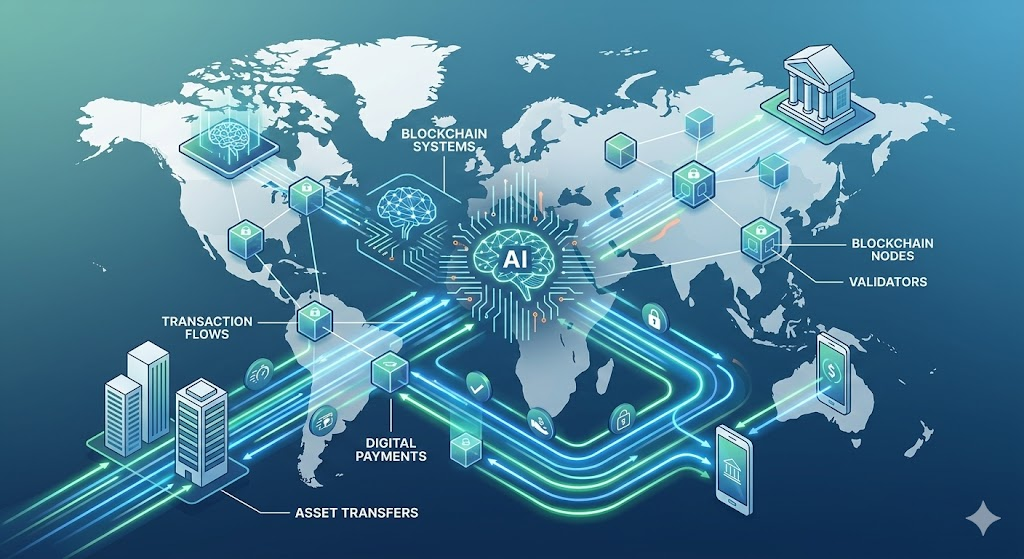
One of the strongest implications for AI and crypto lies in autonomous AI agents. As systems become more independent, they may engage in machine-to-machine transactions. These agents optimize strictly for cost and speed. They do not tolerate unnecessary fees. They do not rely on habit or brand loyalty. Their decisions are based on efficiency.
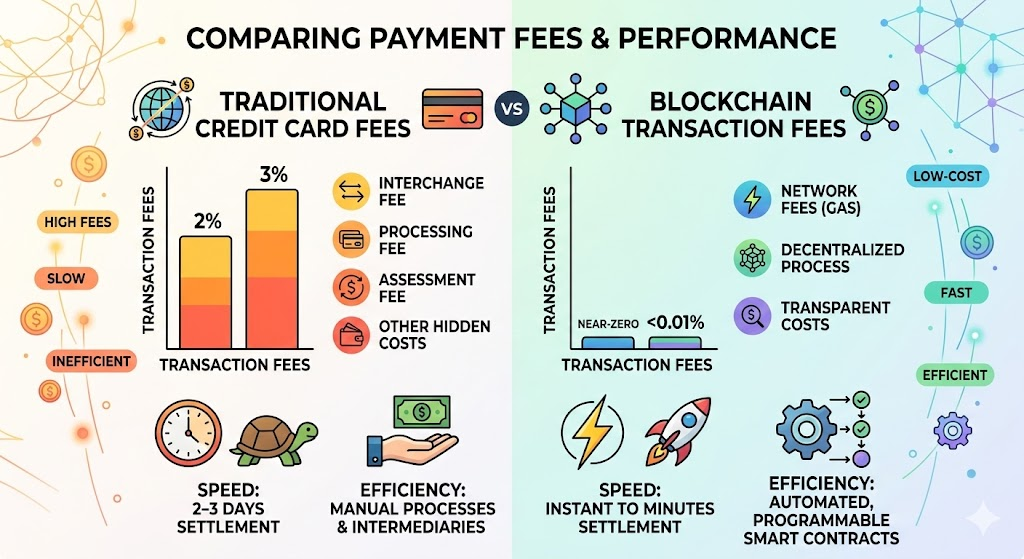
In machine-driven commerce, paying 2 to 3 percent in credit card fees makes little sense. Traditional payment rails were designed for human convenience, not automated micro-transactions. This creates structural pressure toward infrastructure that offers near-instant settlement, minimal fees, and programmable execution.
Why might crypto infrastructure benefit from AI adoption?
Crypto infrastructure offers characteristics aligned with machine optimization. Stablecoins enable digital settlement without banking delays. Low-fee blockchains such as Solana process transactions at very low cost. Ethereum layer 2 networks such as Base, Arbitrum, Optimism, and Polygon offer similar efficiency with near-instant settlement and programmable smart contracts.
When machines transact, they will likely prefer the most efficient rails. Fees measured in fractions of a cent and fully programmable transactions create a structural advantage for blockchain payments. This is not purely theoretical. Major exchanges and platforms are already experimenting with on-chain AI payments, exploring how automated systems can settle value directly on crypto networks.
Will markets collapse or rotate?
Rather than systemic collapse, a more probable outcome is capital rotation. As AI reshapes cost structures and business models, money may move away from per-seat SaaS models and labor-heavy service structures. Capital could instead flow toward AI infrastructure, energy and compute resources, data centers, and blockchain settlement systems.
AI does not necessarily destroy markets. It reshapes them. Reshaping creates volatility, especially during transition periods. For investors, this means that price swings may intensify as narratives change and capital reallocates across sectors.
What does this mean for Diamond Pigs?
At Diamond Pigs, we do not rely on a single long-only strategy. Crypto is inherently volatile, and this volatility may increase in a world shaped by AI acceleration and rapid capital rotation. A rigid approach is not sufficient in such an environment.
Our approach is structured and adaptive. We study how bull and bear market conditions evolve. We rotate between bots designed to perform best in different environments. During drawdowns, we deploy bots that historically perform better in bear market conditions. We focus on coins with proven multi-cycle track records, sufficient market capitalization, and strong exchange liquidity. We align with structural growth narratives such as crypto payment rails, tokenization, and AI-driven infrastructure. We also actively experiment with strategies that can take short positions when market conditions justify it.
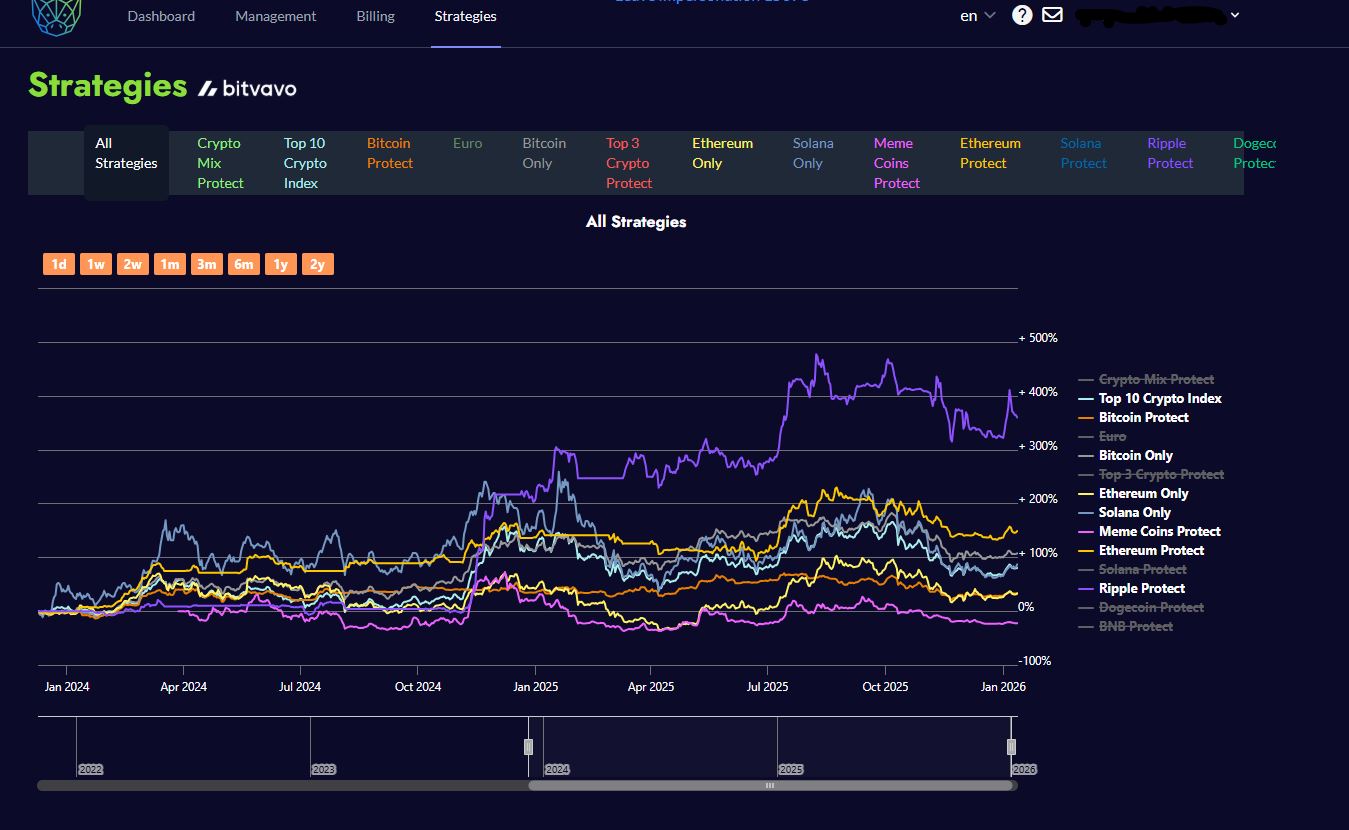
In a fast-changing environment, flexibility is essential. Automated crypto strategies, disciplined risk management in crypto, and continuous performance tracking allow us to adapt rather than react emotionally to headlines.
Conclusion
The AI “doom loop” scenario is possible, but it is not inevitable. While AI economic impact will undoubtedly challenge labor markets and legacy financial models, it also drastically lowers the cost of intelligence and unlocks unprecedented efficiency.
Crypto infrastructure, particularly low-cost settlement networks and stablecoins, may benefit in a world where autonomous AI agents transact directly. Rather than predicting a single outcome, the more rational approach is to prepare for volatility and structural rotation.
At Diamond Pigs, our objective is clear. We adapt to changing conditions. We focus on liquid, resilient assets. We rotate strategically between bull and bear environments. And we prioritize disciplined risk management over speculation.
The AI era may reshape the economy. Our role is not to fear it, but to navigate it with structure, clarity, and long-term perspective.
Frequently Asked Questions
Is the AI doom loop inevitable?
No. The scenario described by Citrini Research outlines a possible outcome, not a guaranteed one. Economic systems are complex and adaptive, and technological progress often creates new forms of demand alongside disruption.
Whether AI leads to contraction or expansion depends on how quickly new industries, income models, and productivity gains balance labor displacement. The outcome is uncertain, which makes flexibility important for investors.
Why would AI agents prefer blockchain payments?
AI agents optimize for efficiency. They evaluate transaction fees, settlement speed, and programmability. Traditional payment systems with percentage-based fees are less suited for automated micro-transactions.
Blockchain networks and stablecoins offer low fees, near-instant settlement, and programmable logic. These features align naturally with machine-to-machine commerce, creating a potential structural advantage.
Could AI increase crypto volatility?
Yes. As capital rotates between sectors influenced by AI narratives, crypto markets may experience intensified volatility. Thematic shifts can accelerate inflows and outflows across specific assets.
This environment reinforces the importance of structured crypto portfolio management and risk control. Adaptive strategies can help manage drawdowns while remaining positioned for long-term growth.
How should investors respond to AI-driven uncertainty?
Investors should avoid binary thinking. The future is unlikely to be pure collapse or uninterrupted growth. A balanced crypto investment strategy should account for volatility, liquidity, and structural trends.
Disciplined allocation, exposure to liquid assets with proven resilience, and adaptive automated trading systems can support long-term stability. The focus should remain on protecting capital while participating in structural opportunities.
Related Posts
.png)
Hot wallet vs. cold wallet: which one do you need?
Crypto rebalancing discipline: control your instincts
.png)
.png)
Crypto self-custody security: your 2026 checklist guide
Never miss another article
Sign up to our email list to receive monthly newsletter.