.svg)

What is swing trading in crypto? A structured guide for long-term investors
What is swing trading in crypto? Learn how entering, holding and exiting works, how risk is managed, and how structured strategies reduce emotional trading.
.png)
Swing trading in crypto focuses on capturing medium-term price movements over days or weeks. It follows a structured cycle: enter, hold, exit. Risk management is defined before each trade through clear stop-loss and profit-taking rules. Unlike day trading, it avoids constant monitoring and emotional decisions. When supported by data-driven automation, swing trading can offer a calm and disciplined way to navigate crypto volatility.
Table of contents
- What is swing trading in crypto?
- How does entering, holding and exiting a position work?
- How does swing trading work in practice?
- What is the difference between swing trading and day trading?
- Which indicators are used in crypto swing trading?
- How is risk managed in swing trading?
- What role do data-driven strategies and automation play?
- How does the Diamond Pigs platform apply swing trading?
- What are the advantages and limitations of swing trading?
- Is swing trading better than long-term holding?
- Is swing trading suitable for long-term investors?
- Conclusion
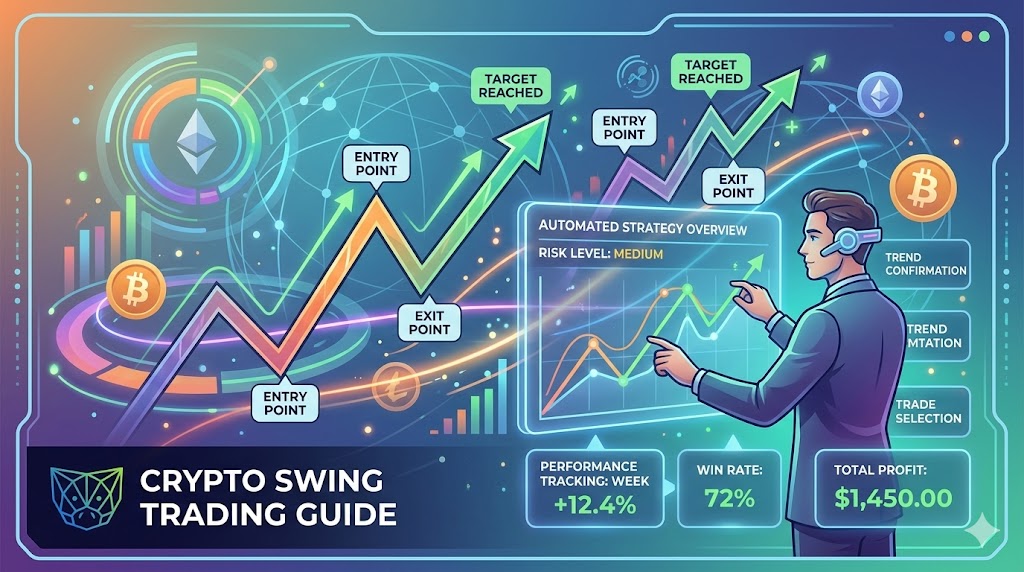
What is swing trading in crypto?
Swing trading in crypto is an investment strategy that aims to capture meaningful price movements over several days or weeks. Instead of reacting to every short-term fluctuation, swing traders focus on confirmed trends and participate while those trends remain intact.
It sits between day trading and long-term holding. It is more active than buying and holding for years, but far less reactive than opening and closing positions within the same day. The goal is not to predict every move. The goal is to participate in structured upward trends and step aside when market conditions weaken.
How does entering, holding and exiting a position work?
Entering a position means buying a cryptocurrency after clear signals indicate that a trend is forming. In swing trading, this decision follows predefined criteria. For example, a coin may form higher highs and higher lows, supported by increasing trading volume. This confirms that buyers are willing to pay progressively higher prices.
Holding a position means staying invested while the trend structure remains intact. Prices may fluctuate during this phase. That is normal. As long as the broader structure supports the original analysis, the position remains open. Exiting happens either when a predefined profit target is reached or when the price drops below a defined stop-loss level. This structured cycle - enter, hold, exit - creates discipline and limits emotional reactions.
How does swing trading work in practice?
Swing trading relies primarily on technical analysis and structured evaluation of price behavior. Historical price data, momentum indicators, and trend confirmation signals are used to determine whether probability favors continued upside. Decisions are based on data, not headlines or social media sentiment.
Unlike day trading, swing trading uses higher timeframes such as two-hour or four-hour charts. These timeframes filter out noise and reduce overreaction to short-term volatility. Because crypto markets operate 24/7 and often move in strong momentum phases, they can offer extended trend opportunities. However, volatility can also reverse trends quickly. That is why exit rules are essential.
What is the difference between swing trading and day trading?
The main difference lies in time horizon and intensity. Day trading involves opening and closing positions within the same day. It often requires constant monitoring and rapid execution. Traders focus on small price movements and high trade frequency.
Swing trading focuses on larger directional moves over several days or weeks. It requires fewer trades and less screen time. This lower frequency can reduce transaction costs and emotional pressure. For private investors who value structure over speed, swing trading often feels more manageable and aligned with long-term crypto investment goals.
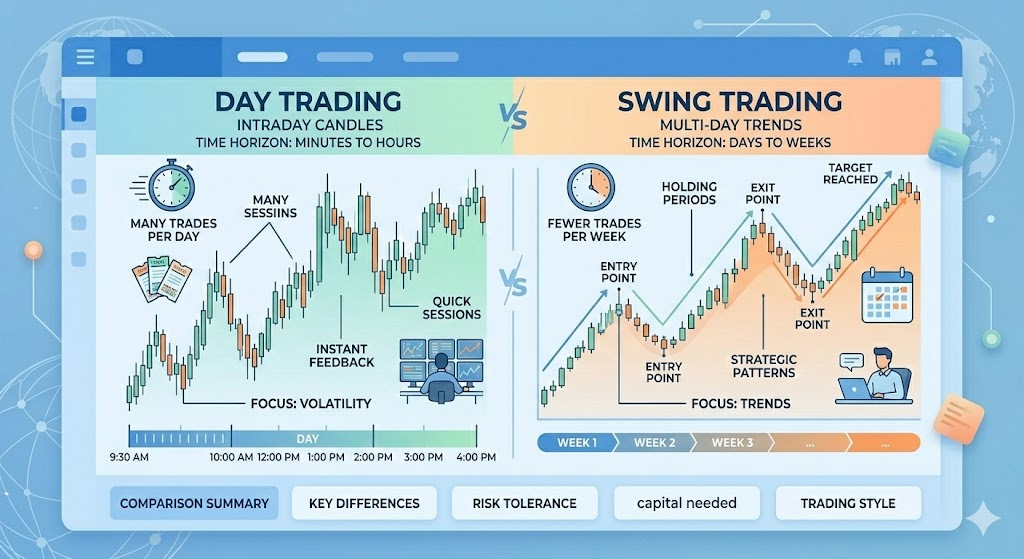
Visual comparison between day trading and swing trading time horizons
Which indicators are used in crypto swing trading?
Swing trading uses technical tools to identify trend strength and potential reversals. Common indicators include trend structure analysis, moving averages, volume confirmation, and momentum oscillators such as RSI or MACD. These tools help assess whether buying pressure supports continuation.
More advanced automated crypto strategies may combine these indicators with data-driven models. At Diamond Pigs, data-driven strategies are supported by intelligent AI models that optimize signal interpretation. Technology supports decision-making, but the logic remains transparent and structured. The goal is clarity and consistency, not complexity.
How is risk managed in swing trading?
Risk management is defined before entering any trade. This includes determining position size, acceptable loss levels, and profit targets. A stop-loss level limits downside if the trend fails to continue. This prevents a small loss from becoming a large one.
Profit-taking levels are also predefined. Securing gains at structured levels prevents greed from overriding discipline. In volatile crypto markets, this balance between protection and opportunity is essential. No strategy removes risk entirely, but structured risk management creates predictability within uncertainty.
What role do data-driven strategies and automation play?
Modern swing trading increasingly relies on data-driven systems. Instead of relying on emotion, algorithms analyze historical patterns and real-time data to evaluate probability. This reduces impulsive decisions and increases consistency.
Within automated crypto strategies, this process becomes systematic. The system scans markets continuously, identifies qualifying setups, executes trades, and manages exits automatically. Investors maintain control over their assets while technology handles execution. This combination supports disciplined crypto portfolio management without constant monitoring.
How does the Diamond Pigs platform apply swing trading?
The Diamond Pigs platform applies swing trading methodology within its active strategies. Bots focus on identifying bullish trends and entering long positions when confirmation criteria are met. They operate primarily on two-hour and four-hour timeframes to reduce noise.
When a position reaches its optimal profit level or falls below a defined risk boundary, the system exits automatically. This approach avoids day trading behavior and short-term speculation. It focuses on structured participation in meaningful directional moves, aligned with long-term wealth growth rather than rapid trading activity.

What are the advantages and limitations of swing trading?
Swing trading offers several advantages when applied with discipline. It captures larger price movements compared to short-term trading. It reduces trading frequency and emotional stress. It allows structured risk management. It can also be integrated into automated crypto bots for consistency.
However, it still carries risk. Crypto volatility can lead to sudden price reversals. Trends do not always continue as expected. Periods of sideways markets may reduce opportunities. Like any crypto investment strategy, swing trading requires patience and realistic expectations.
Is swing trading better than long-term holding?
Swing trading and long-term holding serve different purposes. Long-term holding assumes that the asset will appreciate over years despite interim volatility. It requires patience and tolerance for drawdowns.
Swing trading aims to actively participate in upward trends while stepping aside during confirmed weakness. Some investors combine both approaches. Others prefer structured automated crypto strategies that integrate swing logic with protective elements. The right choice depends on time availability, risk tolerance, and investment philosophy.
Is swing trading suitable for long-term investors?
Swing trading can suit long-term investors who want structured participation without constant trading. It provides more flexibility than pure buy-and-hold while avoiding the intensity of day trading.
It is especially suitable for investors who prefer predefined rules over emotional decision-making. When combined with data-driven automation and clear risk management, swing trading becomes a calm and structured method of navigating crypto volatility within a broader portfolio strategy.
Conclusion
Swing trading in crypto is about structured participation in medium-term trends. It starts with confirmed entry. It continues with disciplined holding. It ends with predefined exits that either secure profits or protect capital.
It does not promise certainty. It provides structure. For investors who seek clarity, control and steady exposure to digital assets, swing trading - especially when supported by data-driven automation - can form a balanced foundation for long-term crypto investing.
Gerelateerde berichten

Crypto scams in 2026: zo herken je ze op tijd

Zo bescherm je je seed phrase (zonder hem kwijt te raken)
.png)
Hot wallet vs. cold wallet: wat heb jij eigenlijk nodig?
Mis nooit meer een artikel
Meld u aan voor onze e-maillijst om de maandelijkse nieuwsbrief te ontvangen.